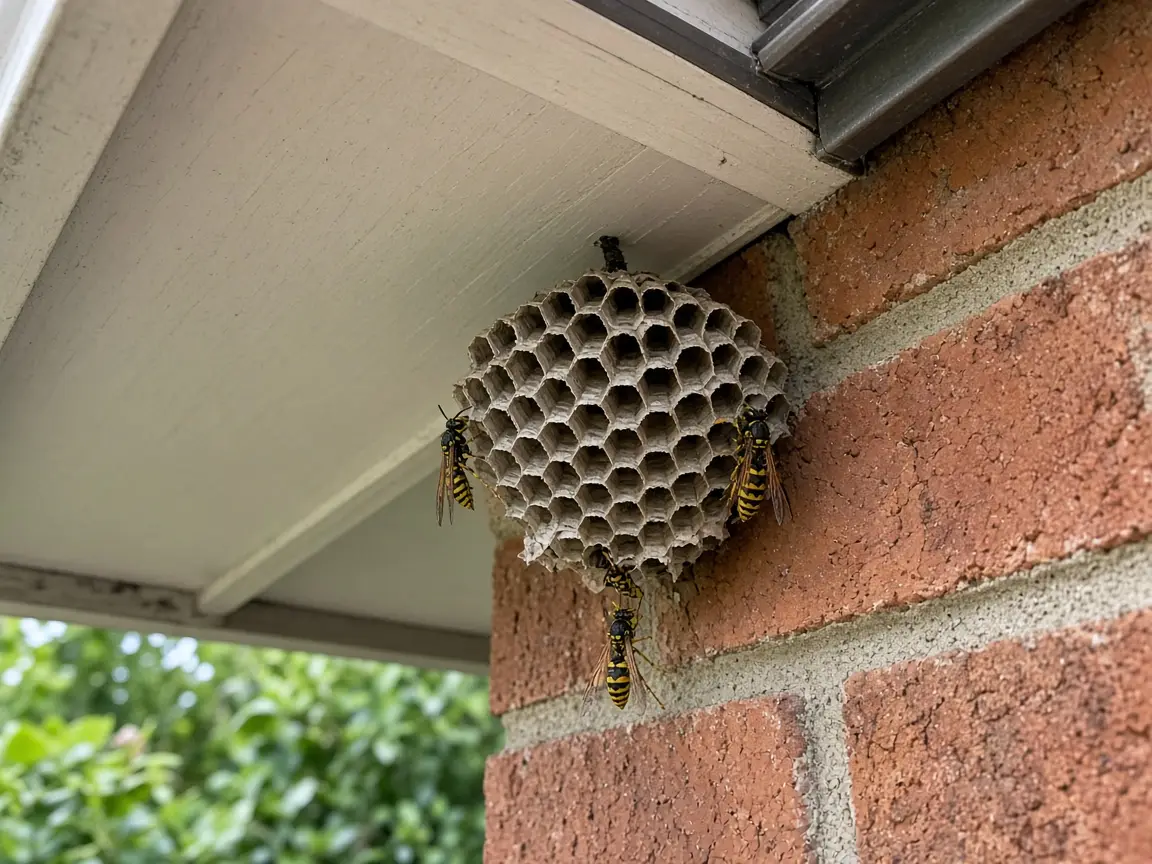
Paper wasps build open combs under eaves, porch ceilings, and railings. Yellowjackets often use a cavity in the ground, a wall, or a play structure.
Hornets build larger enclosed nests in trees or on buildings. The insect at a soda can is not the nest.
The visit has to find where they are coming from before anyone blocks a hole.
What to do before the appointment
Stay back from the flight path. Note the time of day you see traffic and the surface they disappear into.
Do not knock the nest down and do not spray a wall void and then caulk it.
Insects that cannot leave through the original opening look for another way, which is often an interior light or a bath fan.
If someone in the household has a known sting allergy, say that when you call so the timing and the distance you keep can be planned.
This page is not medical advice for a sting.
What the written scope should name
The proposal should name the kind of nest if it can be identified, where it is, whether a ladder or a wall opening is required, and whether a return is included if activity continues.
A single exposed comb is often a one-time job. A wall void can need a follow-up to confirm the opening can be closed.
Honey bee colonies are a different conservation and removal question and are not treated as wasps on this page.
If the insects are bees on a comb you want saved, say so before anyone arrives.
Late summer yellowjacket pressure at outdoor meals can be a foraging problem from a nest that is not on your lot. A visit can still look.
It should not promise the neighborhood has no wasps. See yard pests if the complaint is bites from mosquitoes rather than a nest.
What is different about wasps in Lexington
Paper wasps and yellow jackets build nests under eaves, in wall voids and in the ground, with the largest colonies in late summer.
Climate matters here. Lexington has four distinct seasons with cold winters, warm humid summers and a long spring, so pests move indoors in fall and surge again as the ground warms.
Wasp species you may find in Lexington
Different species need different answers. Around Lexington our technician will usually be looking for:
- Paper wasp (Polistes spp.): slender, builds open umbrella-shaped nests under eaves and railings.
- Yellowjacket (Vespula and Dolichovespula spp.): stocky and yellow and black, often nests in the ground or in wall voids.
What is checked during a wasp visit
For wasps, expect our technician to check:
- Do not close up the expansion joint before the inspection for wasps in Lexington, or the useful evidence is gone.
- The species, because paper wasps, yellowjackets, hornets and mud daubers behave very differently.
- Grills, trash cans and outdoor eating areas that draw foraging wasps.
- The traffic into the entrance, which shows how large the colony is.
- Gaps in siding, attic vents and wall voids, where yellowjackets and hornets can build a nest you cannot see.
- The size and position of the nest and whether it can be reached safely.
The methods used against wasps
What decides the wasps plan in Lexington is the building near Nicholasville, and the irrigation valve is on that list.
- Sealing the entrance after the colony has stopped, not before, so wasps are not trapped inside the wall.
- Screens and sealed gaps to discourage new nests, and early-season checks when a queen starts a nest.
- Removal of the nest after treatment, so it does not draw other insects or invite new queens.
- Dust formulations for wall voids and ground nests, so the colony is treated at the source.
- Treating the nest at dusk or dawn, when most of the colony is inside and less active.
In Lexington, wasps near Beaumont are traced from the garage-door sweep, not from a product chosen before anyone looks.
What makes wasps harder to solve
For wasps in Lexington, the visit starts at the weep holes and then follows whatever that shows.
- Sealing the entrance of a wall nest while the colony is alive, which can send wasps into the living space.
- Spraying in the middle of the day when the whole colony is active.
- Blocking a ground nest hole and leaving wasps to dig a new exit.
- Using a ladder to reach a nest above ground level without help.
- Knocking down a nest with a broom, hose or stick, which provokes a defensive attack.
Your questions about wasps.
Does one sighting of wasps near Georgetown mean a bigger problem?
Only the smallest, most accessible nests, and never if anyone is allergic. Anything inside a wall or attic, in the ground or high up needs a professional with the right equipment.
Why do wasps keep returning in Lexington?
Look at the body and the nest.
Slim wasps with dangling legs and open comb are paper wasps; stocky yellow-and-black insects nesting in the ground are yellowjackets; large insects with a closed paper ball are hornets.
When are wasps most aggressive?
Late summer and early fall, when colonies are biggest and food is scarce. Vibrations and movement near the nest at any time can provoke them.
Will wasps come back to the same spot?
Old nests are not reused, but queens often choose the same sheltered spots the next spring. Removing the nest and sealing or screening the site reduces repeat nests.
What should I do if wasps are inside the house?
Stay calm, close the room and look for an entrance in a wall or attic. Do not seal the opening, because wasps can chew through drywall into the living space.
Do wasp traps work?
Early-season traps can catch queens and foragers, but they do not remove a nest that already exists. They are a support, not a solution.
What if someone is allergic to stings?
Treat any nest as an emergency risk for them. Keep them indoors during treatment, give our technician notice and ask a doctor about carrying emergency medication.
What is different about wasps in Lexington?
Paper wasps and yellow jackets build nests under eaves, in wall voids and in the ground, with the largest colonies in late summer.
Near downtown Lexington, wasps turn up at the attic hatch before they turn up in the main rooms.