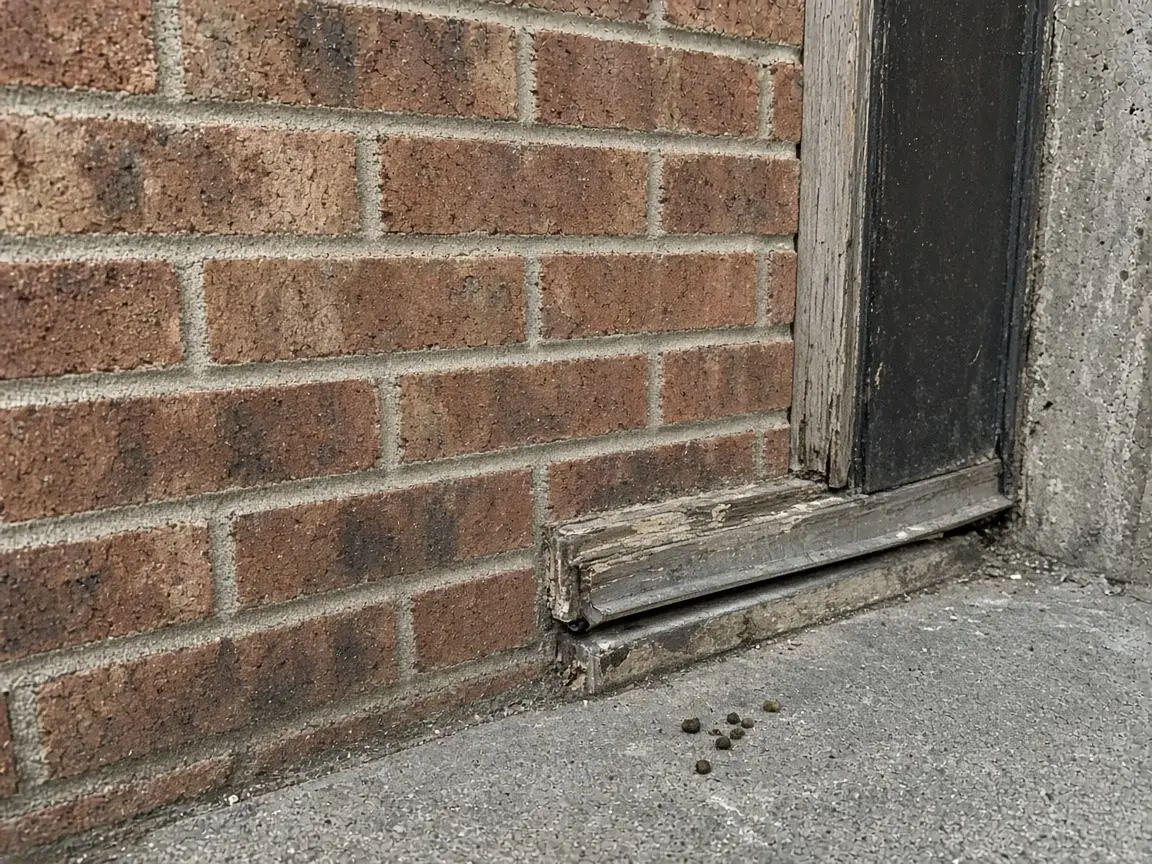
House mice are small, can live in a wall on a modest food source, and leave pointed droppings.
Norway rats are larger, leave blunter droppings, and are more often tied to burrows, heavier gnawing, and lower levels of a building.
Both use gaps that look minor: a chewed door sweep, a pipe through brick, a garage-door corner, a dryer vent, a soffit that has pulled away.
Rub marks along a run and gnawed food packaging support the droppings. One dropping in a garage is a reason to look, not a count of the population.
What this service includes
The visit looks for droppings, runs, and the opening that explains them.
Exclusion is in scope when the opening can be closed as part of the pest job: sweeps, simple seals at penetrations, and screens that do not defeat the vent.
Rodents around Chevy Chase follow the way the house is built, and the door threshold is one of the first places checked.
Do not expect this page to fold them into "rodent control."
Winter is when many Lexington calls start, because heated voids are attractive once nights freeze. The opening was usually there in October. Older brick and limestone foundations, additions, and garage conversions are common places.
Newer siding can hide a gap at the sill, which is why a winter photo of a pretty elevation is not an inspection.
Traps, stations, and cleanup
Trapping and monitoring are tools. A trap line that ignores a one-inch gap under the garage door is a temporary reduction.
Stations, if used, should be placed where children and pets are considered, and they should be checked. This page does not give a poison layout or a homemade bait recipe.
Droppings can carry pathogens. CDC guidance on rodents emphasizes sealing entry points and careful cleanup.
It does not make every dusty cupboard a hazmat event, and it does not make a shop-vac the universal tool.
Ask the inspector what cleanup is reasonable for the amount you actually have, especially in an attic or a closed wall.
Buildings that change the job
A restaurant dock, a warehouse door left open for deliveries, and a house with a basement hatch are different inspections. Pet food in a garage is a food source you can move tonight.
A sewer-related rat issue at a floor drain is not solved by a cleaner floor alone.
The quote should name mice or rats if that is what the evidence supports, the areas included, the openings to be closed, and whether a recheck is part of the price.
See also inspection and commercial doors and docks.
Rodents in Lexington: local conditions
House mice and Norway rats move into basements and wall voids in fall, and roof rats are less common but can reach attics along trees and wires.
Climate matters here. Lexington has four distinct seasons with cold winters, warm humid summers and a long spring, so pests move indoors in fall and surge again as the ground warms.
The rodents that homeowners in Lexington meet
If you have seen rodents near Tates Creek corridor, leave the gable vent as you found it and photograph it.
- If you have seen rodents near Beaumont, leave the soffit gap as you found it and photograph it.
- Near Beaumont, rodents turn up at the attic hatch before they turn up in the main rooms.
- In Lexington, rodents near Versailles are traced from the garage-door sweep, not from a product chosen before anyone looks.
What to look for near Hamburg
A thorough rodent inspection around Lexington covers:
- Near Versailles, rodents turn up at the dryer vent before they turn up in the main rooms.
- What decides the rodents plan in Lexington is the building near Chevy Chase, and the irrigation valve is on that list.
- The rodents check in Lexington covers the block fence and the stored firewood on the same walk-through.
- The rodents check in Lexington covers the block fence and the stored firewood on the same walk-through.
- Near Chevy Chase, rodents turn up at the attic hatch before they turn up in the main rooms.
- Do not close up the expansion joint before the inspection for rodents in Lexington, or the useful evidence is gone.
Rodents in Lexington: what people ask.
Does one sighting of rodents near downtown Lexington mean a bigger problem?
In Lexington, rodents near Ashland Park are traced from the ridge vent, not from a product chosen before anyone looks.
Why do rodents keep returning in Lexington?
Sealing first can trap animals inside and push them to chew a new way out.
Our technician needs to see the routes they use, trap what is inside and then close every opening so that new animals cannot follow.
What does an inspection for rodents look for near Tates Creek corridor?
Near Versailles, rodents turn up at the attic hatch before they turn up in the main rooms.
Do not close up the stored firewood before the inspection for rodents in Lexington, or the useful evidence is gone.
What does an inspection for rodents look for near Chevy Chase?
The rodents check in Lexington covers the block fence and the stored firewood on the same walk-through.
What should I have ready for a visit in Lexington?
Near downtown Lexington, rodents turn up at the dryer vent before they turn up in the main rooms.
Do not close up the stored firewood before the inspection for rodents in Lexington, or the useful evidence is gone.
What does an inspection for rodents look for near Ashland Park?
Near Tates Creek corridor, rodents turn up at the attic hatch before they turn up in the main rooms.
If you have seen rodents near Ashland Park, leave the soffit gap as you found it and photograph it.
Why do rodents keep returning in Lexington?
Often within a week or two. If you still hear scratching after the agreed period, ask for a re-check of the traps and the sealed openings.
Why do rodents keep returning in Lexington?
House mice and Norway rats move into basements and wall voids in fall, and roof rats are less common but can reach attics along trees and wires.
What decides the rodents plan in Lexington is the building near Nicholasville, and the irrigation valve is on that list.