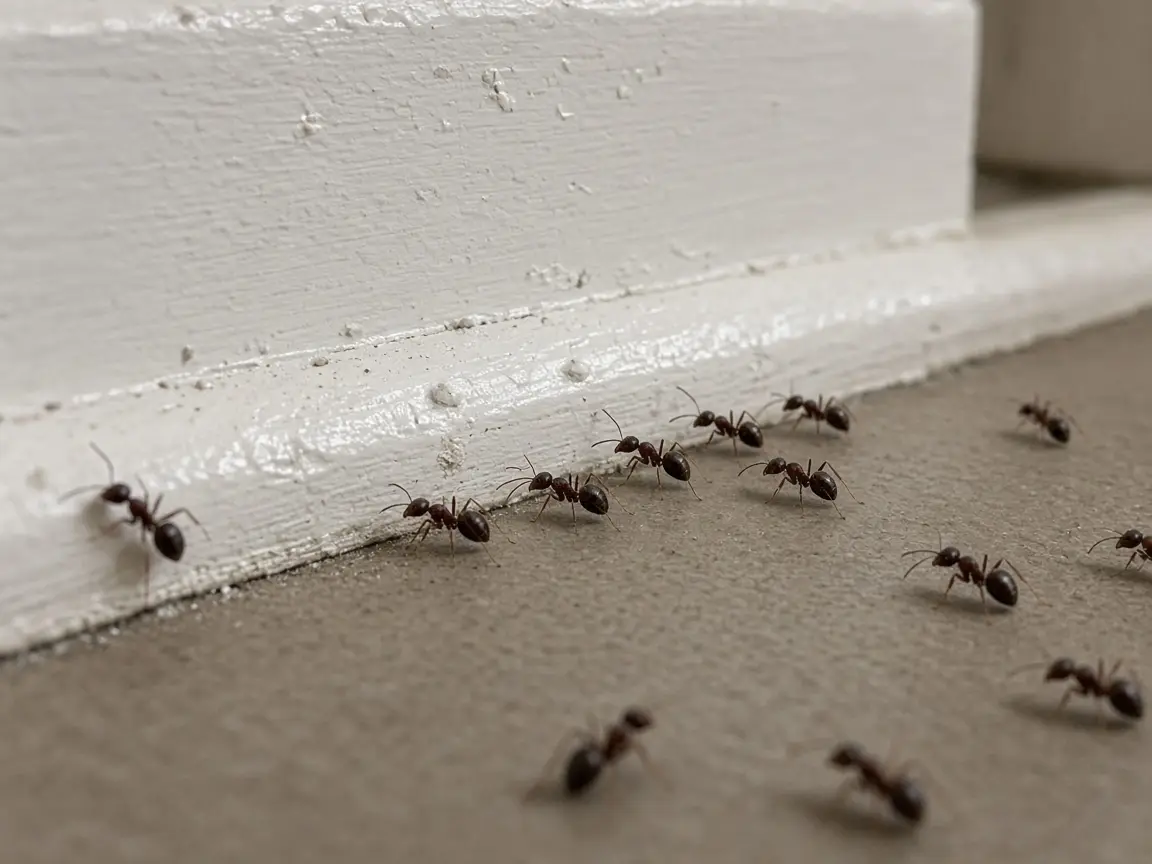
Most ant calls in Lexington start the same way: a line on a counter, a windowsill, or the track of a sliding door.
That line is evidence of a trail, not a finished identification. Odorous house ants and pavement ants are common indoor followers of sweets, grease, and moisture.
Carpenter ants are the ants that get confused with termites because they nest in damp wood. A single photo rarely separates them.
What the trail does and does not prove
Ants have a pinched waist and elbowed antennae. When swarmers are present, the wings are unequal in length. Subterranean termite swarmers have a broader waist, straighter antennae, and wings of similar length.
If you can save a few intact insects without crushing them, the inspector has a better specimen than a smear on a paper towel.
Spraying the trail before the visit can make the ants vanish for an afternoon and reappear along a different baseboard.
Follow the trail only as far as you can see it. It may end at a window, a pipe penetration, or a flowerpot, or it may disappear into a wall.
The nest can be outside under a patio, inside a damp porch column, or in a neighbor's unit if you share a wall.
Killing the ants you can see does not tell you which of those is true.
Carpenter ants and other ants
Carpenter ants excavate damp or decayed wood. You may see coarse, sawdust-like frass below a window, a porch ceiling, or a hollow-sounding trim board.
They do not eat wood the way eastern subterranean termites do, and they do not build mud tubes from the soil.
Firewood stacked against brick, a leaking gutter above a bay window, and a porch that was enclosed over a wet sill are ordinary places to look in older Fayette County houses.
Newer houses are not exempt: a wet fascia or a deck ledger can be enough.
Pavement ants and odorous house ants are more often a food-and-moisture problem than a wood problem. A rinse of the counter is useful.
It is not a treatment plan for a nest in a wall void. Baits, if they are used, have to match what the ants are taking that week.
Sweets one day and protein the next are a reason the first bait is ignored. The inspector should see the trail before recommending a placement.
What the visit looks at
Outside, the walk includes foundation plantings, mulch against siding, hose bibs, and wood that touches soil or stays wet.
Inside, it includes the rooms where the trail is active, under-sink plumbing, and any wood that sounds soft if carpenter ants are suspected.
A quote should say whether the job is a trail and a likely exterior nest, a damp-wood inspection, or both.
It should also say what you need to do with pet food and open pantry items.
Follow-up matters when the nest was not reached or when a neighboring unit keeps the trail supplied. One afternoon of quiet is not the same as a resolved nest.
Exclusion of a obvious gap is worth doing when ants are using it, and it is a different line of work from a bait placement.
Limits
This page does not give bait recipes or spray rates. It does not promise the ants will be gone in a fixed number of days.
If the insects are termites, the work moves to the termite page. If the issue is stored food, say so; pantry pests are a different inspection from a carpenter ant nest. Related reading: what an inspection covers.
Ants in Lexington: what people ask.
What should I have ready for a visit in Lexington?
Wiping removes the scent trail but not the colony.
If the nest is still active, workers lay a new trail within hours, so the lasting fix is to find where the ants come from and deal with that.
Why do ants keep returning in Lexington?
Do not close up the stored firewood before the inspection for ants in Lexington, or the useful evidence is gone.
What should I have ready for a visit in Lexington?
Carpenter ants have a narrow waist, bent antennae and unequal wings when they swarm. Termites have a thick waist, straight antennae and wings of equal length.
Carpenter ants push out sawdust-like frass, while termites leave mud tubes. Keep a sample for the inspection.
Does one sighting of ants near Winchester mean a bigger problem?
The time of year in Lexington changes the pressure, and ants near Chevy Chase are still confirmed at the window well.
What does an inspection for ants look for near Versailles?
For ants in Lexington, the visit starts at the pet door and then follows whatever that shows.
A Lexington home with ants at the crawl-space vent needs that spot named when you call, so the visit starts in the right place.
What should I have ready for a visit in Lexington?
For ants in Lexington, the visit starts at the pet door and then follows whatever that shows.
Homes around Richmond get the ants inspection at the sill plate first, because that is where the activity usually starts.
Why do ants keep returning in Lexington?
A Lexington home with ants at the crawl-space vent needs that spot named when you call, so the visit starts in the right place.
What does an inspection for ants look for near Ashland Park?
A Lexington home with ants at the utility chase needs that spot named when you call, so the visit starts in the right place.
The time of year in Lexington changes the pressure, and ants near Beaumont are still confirmed at the window well.