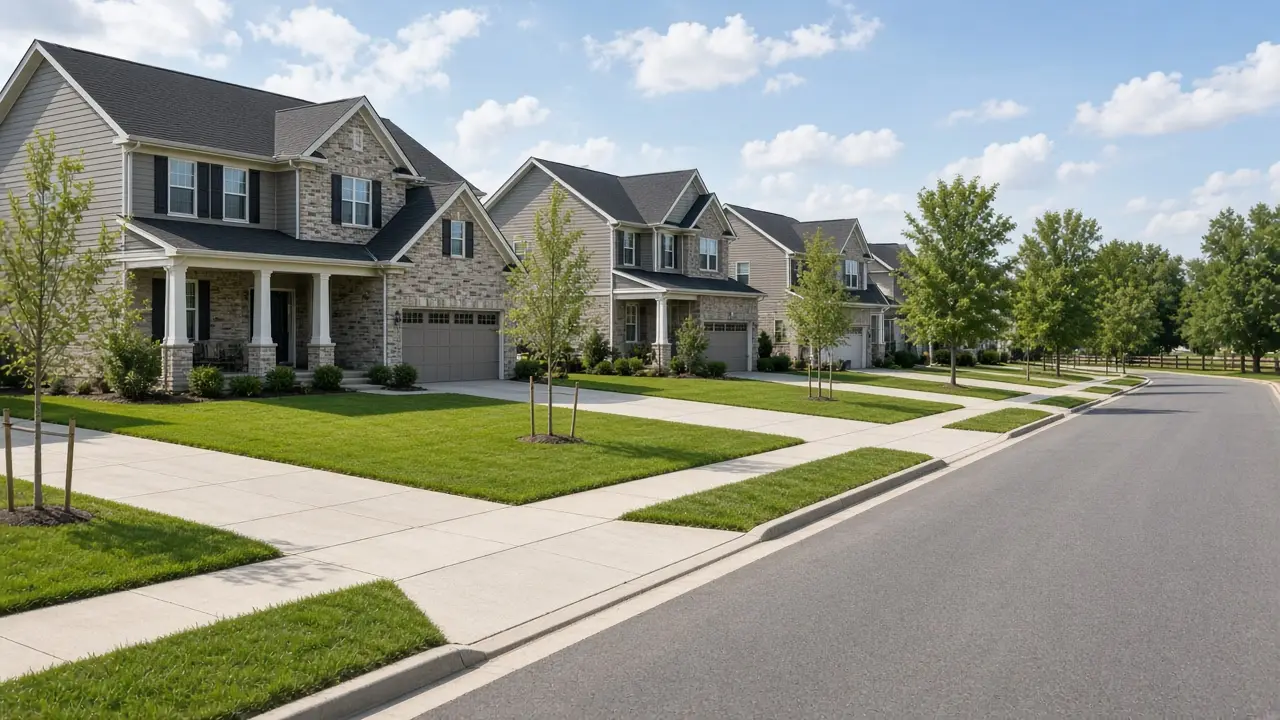
The housing that generates most pest questions here is not a historic limestone cellar.
It is a subdivision built in the last few decades: slab or shallow crawl space, a garage used for storage, irrigation, and a fence line that backs to a drainage swale.
Toyota's manufacturing presence changed where those houses were built. It does not change the biology. Ants follow water and food. Mice follow a gap at the garage. Mosquitoes follow the swale and the buckets.
What the inspection emphasizes
On a newer Georgetown house the first exterior loop is the garage door corner, the patio expansion joint, hose bibs, and any mulch piled on the siding.
Interior trails are often the kitchen on the garage wall. Downtown Georgetown still has older brick and tighter lots.
If that is the building, say so, because the basement or the shared commercial wall is a different hour of work than a subdivision garage.
Industrial-edge properties that are actually warehouses belong on the commercial page, not on a house plan.
Termite inspections still matter on wood that touches soil or stays wet, even in a young house. A general pest visit is not that inspection.
Read the termite page if you have swarmers or tubes. Confirm Scott County scheduling on the call. A Fayette County route and a Georgetown appointment may fall on different days.
Pest control in Georgetown: the setting
Georgetown sits about twelve miles north of Lexington along Interstate 75.
It has a historic downtown around the courthouse, Georgetown College, horse and cattle farms on its outskirts and a large Toyota manufacturing plant that has drawn newer housing, warehouses and logistics sites to the corridor.
That mix gives the town three kinds of pest work. Older downtown brick and frame buildings tend to have mice, cockroaches and the occasional bed bug problem.
The newer subdivisions on the edge of town have landscaped beds against the foundation and see ants, spiders and wasps.
Warehouses and commercial buildings along the corridor have loading docks, waste areas and shared walls where rodents and cockroaches find food.
Seasonal pressure in Georgetown
In spring the soil warms and carpenter ants and termite swarmers appear around foundations and window frames. Through summer, wasps nest in eaves and fly populations rise near farm edges.
As nights cool in the fall, mice and spiders look for warmth, and houses next to open fields tend to see the first rodent activity.
Central Kentucky can swing from mild to freezing within days, which pushes pests indoors early and keeps some of them active all winter in heated buildings.
Mention it when you call if something shows up out of season.
Before you call about a Georgetown property
Requests from Georgetown follow the usual path. Someone takes the address and asks a few questions so the right technician is sent. These details help most:
- Which part of town the property is in, such as downtown, a newer subdivision or the industrial corridor.
- Whether the building is a house, a rental, a business or an outbuilding on a farm.
- Whether the activity is indoors, in the attic or crawl space, or around the yard and garage.
- Whether there are horses, livestock, feed or grain stored on the property.
You do not need the right terms. A plain description and a safely taken photo are plenty.
From request to visit in Georgetown
The technicians who visit Georgetown are our own, and they know the area. You are told who is coming before any treatment starts and you see the scope and price before you decide.
Our technician begins by inspecting the building and its surroundings, then explains the findings, the options and the follow-up.
Tell them about any feature of the property that matters, for example a damp basement or farm buildings close to the house.
Property types we see in Georgetown
People in Georgetown ask about houses, rentals, businesses and outbuildings, and each shapes the visit differently:
- Older buildings with cellars, shared walls or aging masonry, where pests travel out of sight.
- Houses, where the inspection covers the outside, the attic and any basement or crawl space.
- Small businesses and offices, where access and opening hours shape the visit.
- Rentals and apartments, where the landlord or manager should know about the problem and neighboring units may need checking.
Let the person answering know which it is. The answer changes who approves the visit and what is checked first.
Service-area checks signs in Lexington
Most problems are easier and cheaper to deal with in their first weeks than after a season of growth.
If you have seen the same sign twice in Georgetown, that is usually enough reason to ask for a visit rather than wait.
What to write down
A few dated notes and photos make the visit far more useful. Write down where each sign appeared and how often. Anyone inspecting a Georgetown property can then see the pattern at a glance.
Getting the property ready
Preparing takes a few minutes. Make sure our technician can reach the attic, basement or crawl space, store food and pet bowls and write down where and when the problem appears.
Questions Georgetown residents ask
Does the service reach Georgetown?
Yes, we take requests from Georgetown and elsewhere in Scott County, and we tell you before anything is booked whether we can come. Rural roads and places between towns are worth asking about.
How do I describe something I cannot identify?
No. Say what you see, and send a photo if it is safe to take one. The visit identifies the pest, and our technician should explain how.
Who actually does the work?
Yes. The work is done by Lexington Pest Control technicians, and you are told who is coming before the visit.
Beyond Georgetown
Georgetown is the county seat of Scott County.
Requests also come from the other cities in the Bluegrass area, including Nicholasville and Versailles and the neighborhoods of Lexington. The service areas page lists them all.
A rural address or one between towns can still be covered. It depends on whether a professional works near it, so ask.